Most home EV charger conversations start with the charger and end with the panel. A Level 2 charger is often the single largest continuous load ever added to a house — and the National Electrical Code treats EV charging as a continuous load, which changes the math. Whether your panel can take it is the real question, and it is answerable with a load calculation, not a guess.
The 125% rule: why a 48-amp charger needs a 60-amp circuit
NEC Article 625 governs electric vehicle power transfer systems, and because charging runs for hours, the circuit must be sized at 125% of the charger’s maximum current. The common tiers work out like this:
- 16A charging → 20A circuit — adds roughly 12–15 miles of range per hour
- 32A charging → 40A circuit — the sweet spot for most commuters
- 40A charging → 50A circuit — popular because it matches a common receptacle size
- 48A charging → 60A circuit — requires a hardwired unit, not a plug-in
Faster is not automatically better. A 48A unit that forces a service upgrade can cost multiples of a 32A unit your existing panel absorbs easily, and for a car that sits in the garage ten hours a night, both wake up to a full battery.
Hardwired or receptacle?
Plug-in installations on a NEMA 14-50 receptacle look economical until code catches up with the details: a receptacle-fed EV circuit needs GFCI protection under recent cycles, receptacle quality matters enormously under sustained 40A loads (bargain receptacles are a documented melt risk), and chargers above 40A cannot plug in at all. Hardwiring eliminates the receptacle as a failure point, usually satisfies the GFCI question through the charger’s own listed protection, and gives you a cleaner install. Our default recommendation: hardwire anything at 40A and above.
When your panel is the real conversation
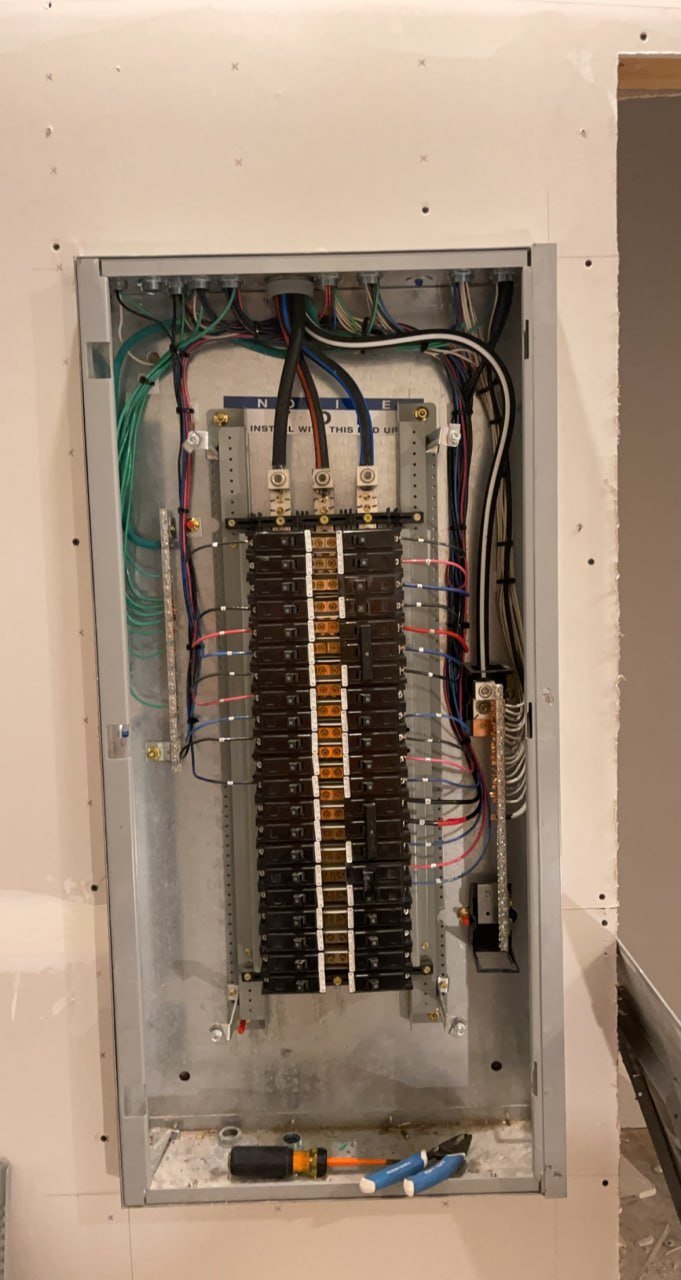
NEC Article 220 load calculations tell us whether your service has headroom. A typical 200A service with gas heat absorbs a 48A charger without drama. A 100A service running an electric range, dryer, water heater, and a heat pump usually does not — and much of the housing stock in our central PA service area still runs 100A panels installed decades ago. When the calculation comes up short, the options in rough order of cost:
- Charge slower. A 20A or 32A circuit that fits the existing service beats a service upgrade you did not budget for.
- Load management. NEC 625.42 allows an energy management system to cap the charger dynamically — the charger throttles when the dryer and range are running. These devices have matured fast and often save thousands.
- Service upgrade. Sometimes right, especially if the panel is a known-problem brand or already out of spaces — at which point the EV charger is the excuse, not the reason.
What an installation visit actually covers
A proper quote is not a picture of your panel texted to a stranger. We verify service size at the meter, run the Article 220 calculation with your real appliance loads, check panel brand and breaker availability, measure the run from panel to parking spot (conductor length and routing drive cost more than the charger brand does), and confirm what your utility and municipality require — permitting and inspection practices differ noticeably among Pennsylvania, Maryland, and Delaware jurisdictions in our service area.
Thinking about a charger — or suspecting your panel is the real project? Get in touch and we will run the numbers before you buy hardware. If the panel does need work, our residential service page covers what a panel or service upgrade involves.
General information, not a substitute for a site-specific load calculation. Code references are to recent NEC cycles; your adopted local edition and amendments govern.